Fearless iconoclasm: changing the course of modern wine
It is no exaggeration to count Josko Gravner among the most influential winegrowers of the past half-century, and in the world of low-intervention wine his impact is perhaps unmatched. Gravner’s revival of the ancient practices of white-wine skin-maceration and subterranean amphorae in the early 2000s was a bold rejection of technology’s ever-increasing role in the winemaking process, and it is a testament to his vision, skill, and tenacity that he experienced such resounding success in light of such a radical reimagining of purpose.
A highly acclaimed producer of technical, stylish Friulian wines in the first part of his career, Josko underwent a crisis of faith in the mid-1990s, realizing that he simply didn’t enjoy drinking his own wines anymore. The story of his perilous journey into the Caucasus mountains and his encounters with millennia-old Georgian viticultural traditions has been well told by now, but in the wine world of 2026, where one can easily mail-order a terracotta jar and indulge in a bit of experimental fun, Josko’s overhaul of his entire methodology stands out even more sharply for its all-in fearlessness.
While his radical shift indeed confused and alienated many at the time, Josko ended up inspiring a legion of growers to abandon the trappings of modern technical winemaking in favor of something more visceral in spirit, and his atavistic wines connected deeply with consumers who yearned for an experience beyond the ordinary. Even today, when the flavors and textures of skin-contact white wines have become far more familiar, Gravner’s achieve a level of expressive power few wines on earth can approach.
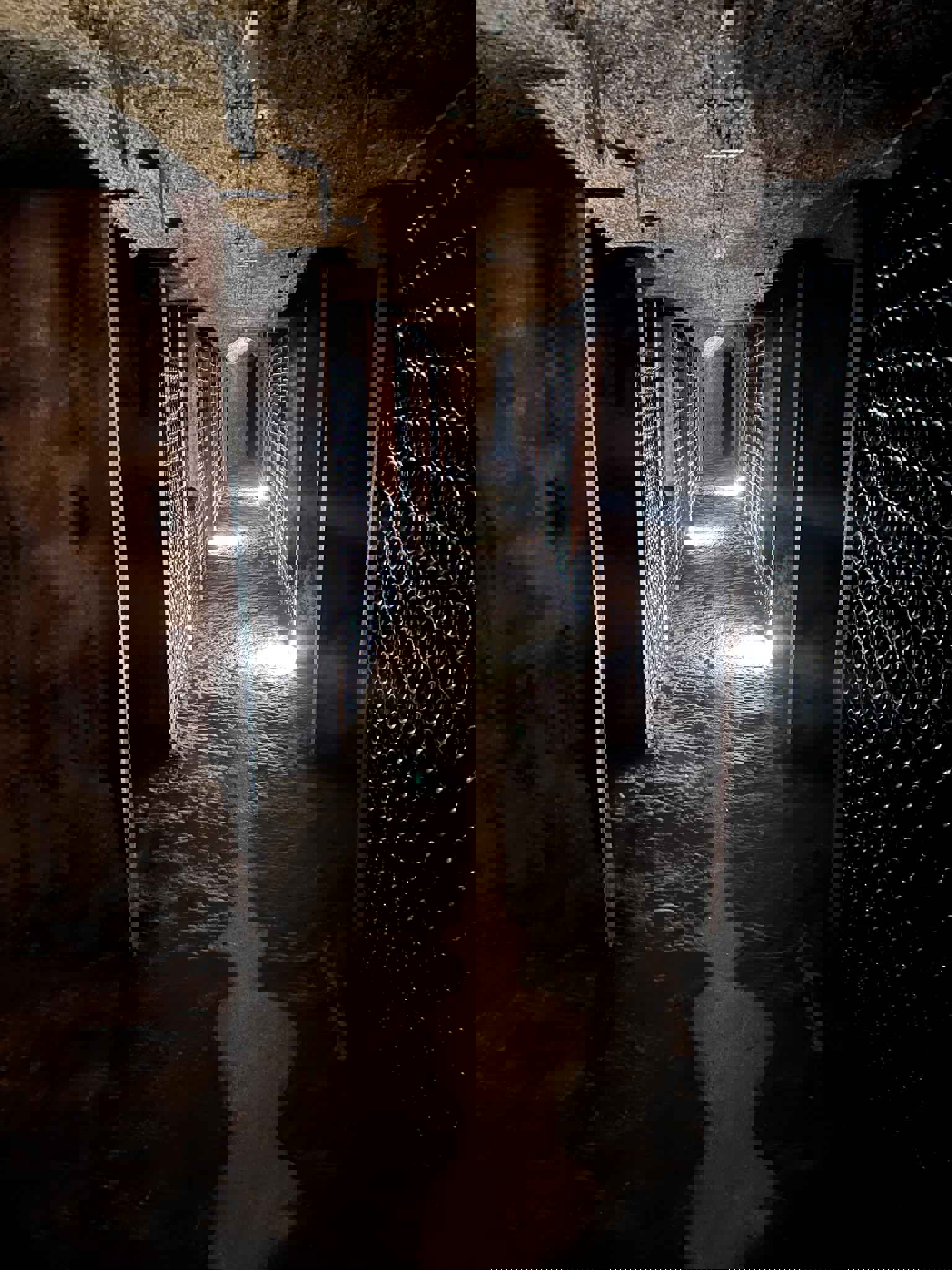
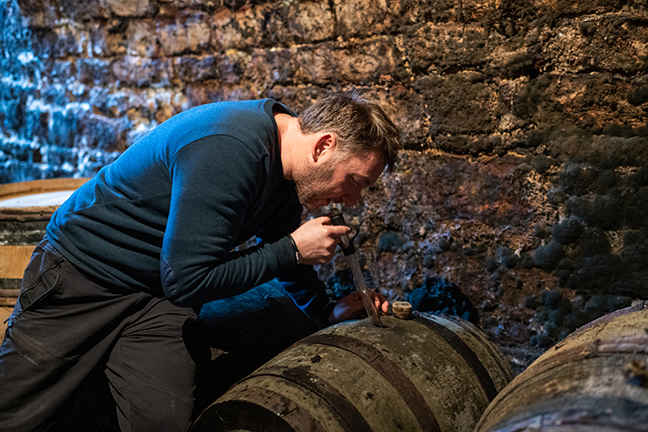
Gravner’s cellar methodology for the indigenous Ribolla is simple, if extreme: bunches, harvested by hand, are placed into subterranean amphorae in his solemnly spartan fermentation cellar, where they macerate for several weeks; the wine is then pressed and moved back into amphorae for five months, then transferred to large Slavonian casks (all well used) for six years before bottling, with nothing added along the way except trace amounts of sulfur, and without fining or filtration of any kind. The wine rests several more years in bottle in Gravner’s deep storage cellar before being released to an adoring public.
The hard-fought 2017 Ribolla: one of a kind
For a winegrower who has made a career out of making things difficult for himself, it is perhaps only fitting that a major anniversary vintage like 2017, which marked 20 years since his initial experiments with skin maceration and amphora aging, presented Gravner with the most arduous growing season of his life. A scorching August, hot even by modern standards, was followed by relentless rain in September and October, leading to rampant rot and delayed phenolic development. While Josko has long prized botrytis-affected vintages for the aromatic and textural complexity they lend his wines, conditions in 2017 required him and his team to harvest the Ribolla bunch by bunch, painstakingly cutting out desirable botrytis-affected fruit and discarding the majority. In the end, all that work netted him just 15% of a normal harvest’s quantity.
2017 challenged Josko not only in the vineyards but in the cellar as well, as the vintage’s hard-won fruit stopped fermenting with nearly 20 grams per liter of residual sugar. One can imagine the gods, seeking always to humble the would-be alchemists who ply their trade as winegrowers, testing the now-famous figurehead of a movement: Just how dedicated to this low-intervention enterprise are you, Josko? In his wisdom, Josko stood by his principles and let the wine be what nature made it: a one-of-a-kind Ribolla which, through an exceedingly difficult birth, ended up unlocking new expressive registers, not only for the grape variety but for Gravner’s usual palette of flavors and textures.
Built around an intricate interplay of truffle-tinged, gently musky, botrytis-marked fruit and a heightened, woodsy, appetizing bitterness, the 2017 Ribolla unfurls in waves across the palate, alternatingly luscious and structured, saline and fruity, its ample but well-disguised residual sugar acting as a bed of viscosity rather than a dollop of overt sweetness. Quite delicious in the present moment, it nonetheless possesses enough heft and concentration—aided by the presence of residual sugar, of course—to develop for decades, and it wears its 15.5% alcohol effortlessly. Furthermore, given its structural tenacity, a bottle can easily withstand being open for at least two weeks without any signs of degradation.
As befits a wine that is unique in every sense of the word, the 2017 Ribolla is packaged in a manner that speaks to Gravner’s uncompromising iconoclasm. Confronted with such a miserly volume of wine, Josko bottled his 2017 only in magnums (only 2,904 in total). Furthermore, he worked with a local artisan to develop a specialized wooden housing unit, sourced from local oak trees, which displays two magnums per box, along with six of the elusive Gravner glasses—distinctive handblown, squat, stemless vessels, formerly available only by visiting the estate, which facilitate aromatic complexity through presenting a large surface area of wine, and whose stemless construction forces the drinker to cradle the wine, thereby slowly and naturally bringing it up to its ideal serving temperature.
A study in contrasts: the graceful 2018 Ribolla
Given the one-off nature of the 2017 Ribolla above, Gravner purposely altered the typical rhythm of his releases, launching the far more typical 2018 Ribolla alongside it rather than waiting until next year to put it up for sale. As frequently happens with successive vintages, 2018 is an inversion of 2017 on almost every level: a properly wet spring led into a hot but tranquil summer with well-timed mild showers, and maturity developed far more readily than in the rain-soaked 2017 season, leading to a slightly early harvest that finished on October 22nd. 2017 and 2018 drastically differ not only in their growing seasons but in the character of the wines themselves: the 2018 Ribolla is lithe and elegant (relatively speaking, of course; this is still Gravner!), clocking in at just 13% alcohol and displaying very little botrytis influence. It offers a clean, driving palate of tangy golden fruits and frank stoniness, overlain by a floral element which more powerful and brooding vintages tend to mask. One senses the relative tranquility of the vintage in the wine’s more open-knit and relaxed personality, and it provides a fascinating counterpoint to the singularly intense 2017.
A pittance of 2011s: the last vintage of non-Ribolla white wines
Through over a decade of gaining experience with his newly forged direction, Josko realized that it was the indigenous Ribolla which provided the truest and most resonant voice for his terroir. Never one for half-measures, he uprooted his Chardonnay, Pinot Grigio, and Sauvignon in 2011 and 2012—plantings from the 1970s and 1980s upon which he had forged his early-career renown—thereby fully breaking with his past. Accompanying the 2017 Ribolla are a scant few offerings from 2011, the final vintage in which Gravner produced white wines from other varieties.
2011 “Sivi Pinot” [magnum-only]
Formerly labeled as “Pinot Grigio Riserva,” this wine was rechristened "Sivi Pinot" (the variety’s Slovene name) with the 2009 vintage. Gravner’s formidable version of this variety shows the immense depth and complexity Pinot Grigio is capable of when treated with respect and an openness to risk. The 2011, produced from a 1974 planting in the Bracnik vineyard, fermented naturally in buried Georgian amphorae with a long maceration, and after pressing and a further five months aging in those same vessels, was moved to old oak casks for six years, then stored in bottle a further seven years before being released into the market. In its luscious power, its staggering breadth, and its palate-staining intensity, it plumbs the outer limits of the variety’s expressive capabilities.
Mixed three-pack of 2011 magnums
This special release includes one magnum each of three miniscule-production 2011s:
-
2011 Sauvignon: Produced from a 1985 planting of Sauvignon Blanc in the Pusca vineyard, this was vinified in the manner of the Ribolla, with extended skin maceration in buried Georgian amphorae, followed by pressing and a return to amphorae for five months, then six years of aging in large neutral Slavonian casks with minimal sulfur additions, followed by seven years of resting in bottle before release. It is an explosive, profound, meditative Sauvignon the likes of which only Gravner can produce, offering a wholly unique take on an often-pedestrian variety.
-
2011 “Sivi” Pinot Grigio: See above.
-
2011 Ribolla “R”: Only in vintages that merit it, Josko separates out the best of his Ribolla at harvest, designating it for a Riserva (hence “R”) and extending its aging regimen both in cask and in bottle, always bottling it only in magnum. While sharing a strong family resemblance with the flagship Ribolla bottling, “R” offers a more pointed sense of umami, greater density and depth, and a resonant sense of harmony frankly shocking for a wine so boisterous and wild.
Beyond skin-macerated whites: Gravner’s rare and ravishing red wines
Although produced in far smaller quantities, Josko’s reds—made from the characterful indigenous Pignolo variety, as well as older plantings of Merlot and Cabernet Sauvignon—undergo aging regimens of mind-boggling durations and stand easily alongside the greatest red wines in Italy.
2010 “Rosso Breg” Venezia-Giulia
The indigenous and little-known Pignolo variety finds an astonishing level of depth, complexity, and visceral power in Gravner’s hands. For this, the “Rosso Breg,” Josko ferments Pignolo spontaneously in subterranean Georgian amphorae, then transfers the wine to well-used Slavonian casks for five years, followed by an astonishing nine years in bottle before release. Kaleidoscopic in its aromas of tobacco, spice, and neutron-star-dense black fruits, the wine all but levitates on the palate despite its intensity, so seamlessly integrated are its elements. A bass note of umami sends this wine into another dimension.
2009 “Rosso Rujno” Venezia-Giulia
Produced only in exceptional vintages, the ultra-rare “Rosso Rujno” is a blend of the Merlot (90%) and Cabernet Sauvignon (10%) that would ordinarily comprise the “Rosso Gravner” but in this case undergo an even longer aging regimen: seven years in barrel, followed by seven years in bottle, before the wine is released. Josko finds profound significance in the number seven; it is the number of years required for the human body’s cells to completely regenerate, and—at any given time, in some real physical sense—we are all completely different people than we were seven years prior. Given the arc of his career, it is perhaps no surprise that renewal is a topic dear to Josko’s heart… Despite its Bordeaux origins, Merlot can achieve notable complexity in the Collio, particularly when handled with Gravner’s level of skill and sensitivity, and the Rosso Rujno is flat-out breathtaking. The vines’ age—56 years as of the 2009 harvest—makes itself known in an overall sense of concentration, but a mineral-drenched freshness dominates the palate even as umami notes swirl and dazzle. Its sense of equilibrium and complexity would shame many a fancy Bordeaux to which it might be compared, but its underlying visceral power and unfettered wildness are Gravner through-and-through.